
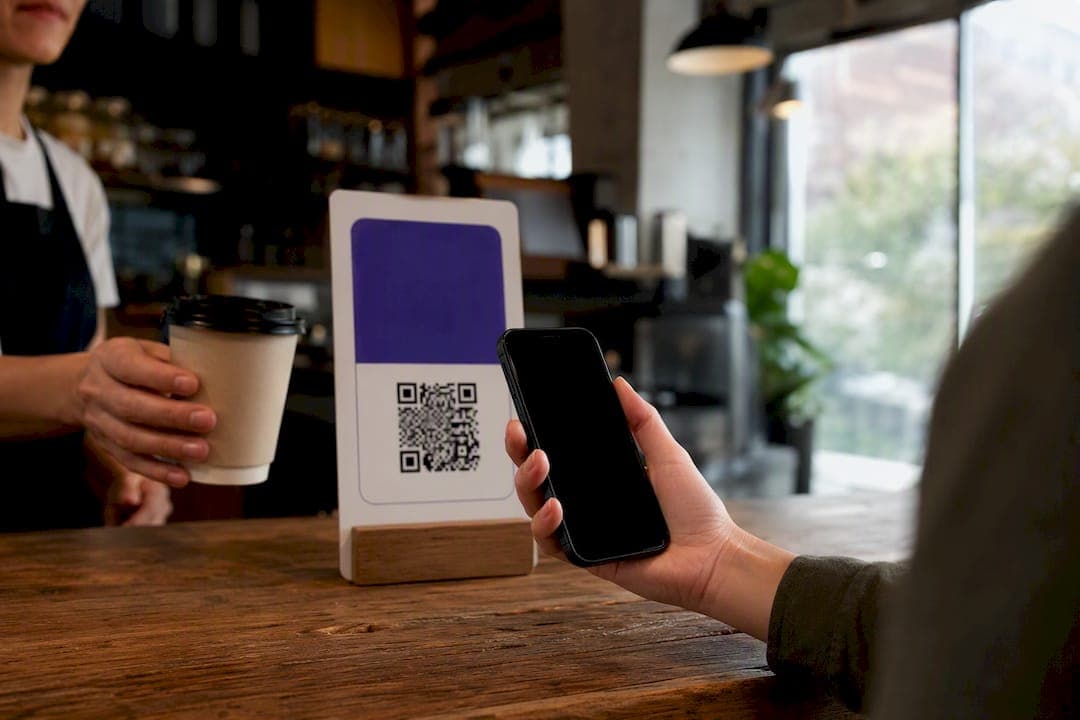
Yes, an independent coffee shop should run a loyalty program, and for most owners the best starting point is a wallet-native digital punch card or a simple POS-based points system, not a custom app or a paper card. The reasoning is straightforward: repeat customers cost far less to keep than new ones to find, and even a bare-bones program raises visit frequency and ticket size without adding real work at the counter.
TL;DR:
- A wallet-native digital punch card or POS-based points system is ideal for independent coffee shops because it boosts loyalty without complicating operations.
- Setting reward thresholds around a customer’s typical spend (such as $50 for ten visits) ensures faster engagement and avoids discouraging regulars.
- Running a simple program with quick first rewards and clear staff scripts significantly increases enrollment and customer retention.
- Rewarding low-margin items and using time-based multipliers can protect margins while encouraging traffic during slow hours.
- Using QR codes for enrollment and automatic reward tracking, such as through Increasify, simplifies setup and improves participation rates.
Table of Contents
- What Is a Coffee Shop Loyalty Program and Which Type Works Best?
- How Do You Pick the Right Program for Your Shop?
- How Should You Set Reward Thresholds and Protect Your Margins?
- How Do You Launch a Loyalty Program Step by Step?
- What Enrollment and Promotion Tactics Actually Move the Needle?
- Which KPIs Should You Track and What Experiments Are Worth Running?
- Real Examples Independent Shops Can Copy
- What Actually Determines Whether a Loyalty Program Works?
- How Increasify Makes This Easy to Set Up and Run
- Sources
What Is a Coffee Shop Loyalty Program and Which Type Works Best?
A coffee shop loyalty program rewards customers for repeat purchases, usually through stamps, points, or spend thresholds that unlock a free item or discount. The mechanic matters less than most owners think. What matters is how fast someone gets that first reward and how little friction it takes for your barista to track it during a Monday morning rush.
Here's how the main formats stack up for an independent shop:
- Punch/stamp cards are dead simple: buy X drinks, get one free. Zero setup cost on paper, but no customer data and easy to fake or lose. On a digital wallet card, the same mechanic gets tracked automatically and can't be duplicated.
- Visit-based programs reward the act of showing up rather than the amount spent. Good for shops that want foot traffic during slow hours, since a visit counts the same whether someone buys a $3 drip coffee or a $9 breakfast combo.
- Spend/points programs award points per dollar, which lets high-ticket customers earn faster. These need POS integration to track accurately. Manual tallying at the register invites errors and slows the line.
- Tiered programs (bronze/silver/gold, or similar) unlock better perks as customers spend more over time. They work well for cafés with a strong regular base but add complexity most single-location shops don't need yet.
- Subscription models charge a flat monthly fee for perks like a daily drip coffee or 10% off everything. These create predictable revenue but require billing infrastructure most indie shops don't have in-house.
- Hybrid and occasion-based perks layer a birthday reward, a first-visit bonus, or a "buy the bag, get the cup free" promotion on top of a core program. These add warmth without replacing the primary mechanic.
On the technology side, Square's research found that customers enrolled in a loyalty program spend 1.67 times more than those who aren't enrolled, and that POS-integrated systems cut staff friction compared with standalone apps. That's the core tradeoff: paper costs nothing but tracks nothing, POS-based points give you real data but need a compatible register, and wallet-native digital cards (saved to Apple Wallet or Google Wallet) split the difference. No app download, automatic tracking, and a QR code is all it takes to enroll. Full custom apps look impressive on a sales deck but see the lowest real-world adoption for single-location cafés, since almost nobody downloads a dedicated app for one coffee shop.
How Do You Pick the Right Program for Your Shop?
The right program depends on what you're actually trying to fix. Start with your goal, not the mechanic that sounds coolest.
- Goal: more frequent visits. A visit-based punch card or stamp system, digital or paper, directly rewards showing up more often.
- Goal: bigger average ticket. A spend/points program that awards more points per dollar nudges customers toward pastries, food, and add-ons instead of just black coffee.
- Goal: stopping customer drop-off. A tiered or hybrid program with a re-engagement trigger (a "we miss you" offer after 20 days of no visits) does more for retention than a flat punch card.
Before picking a mechanic, pull three numbers from your POS: average ticket size, typical visit cadence for your regulars, and your busiest dayparts. If your average ticket is $5.50 and regulars come in three times a week, a points threshold set too high will feel unreachable and kill enrollment. If mornings dominate your traffic, an afternoon double-points promotion can smooth out slow hours instead of just rewarding the rush you already have.
A rough rule of thumb: if you're doing under 50 transactions a day and don't have a POS that supports loyalty tracking, a simple paper punch card is fine to start. Once you're past that volume or want any real data on who's coming back, move to a digital or POS-based system. Paper doesn't scale. You can't email a paper card, and you definitely can't tell which of your punch cards belong to your best customer versus someone who visited once in March.
How Should You Set Reward Thresholds and Protect Your Margins?
The single biggest design mistake independent shops make is setting the reward threshold too high. If a regular customer visits frequently, they should hit their first reward within a few weeks, not months. That fast first win is what gets people to actually use the program instead of forgetting about it after one visit.
Translate that into visits or points directly: if your average ticket is $5, and you want a reward around the 10 visit mark, that's roughly a $50 spend threshold for a points system, or a straightforward "buy 9, get the 10th free" for a punch mechanic. Scale the number up or down based on your own average ticket. A shop with a $8 average ticket can set a higher dollar threshold and still hit that same two to three week window for regulars.
A few practical levers protect your margins while keeping rewards attractive:
- Set the free reward on a mid-margin item (a standard drip coffee, not a specialty latte with three add-ins) so redemption doesn't eat into your best-margin sales.
- Use time-of-day multipliers, like double points on weekday afternoons, to shift demand into slower hours instead of just subsidizing your existing rush.
- Exclude your lowest-margin items (bagged beans, merchandise) from earning points if you're running tight margins on retail.
To check the math, calculate a simple per-reward cost: take the wholesale cost of the free item, divide by the average spend required to earn it, and see what percentage of revenue that represents. A free drip coffee earned after a moderate spend costs you a manageable percentage of that revenue in product cost. That's a manageable number for most cafés.
Pro Tip: Run the margin math on your worst-case scenario, a customer who only ever orders your cheapest drink, before launching. If the program still pencils out there, it'll work fine for everyone spending more.
How Do You Launch a Loyalty Program Step by Step?
Getting a program live doesn't need to take more than a week if you keep the setup tight and focused on one goal.
- Pick one goal. Decide whether you're optimizing for visit frequency, ticket size, or stopping lapsed customers before choosing a mechanic.
- Choose your program type and tech. Match the goal to a format from the list above, then decide between a POS-based system, a wallet-native digital card, or paper, based on your current volume.
- Run the margin check. Confirm your reward threshold and per-reward cost using the calculation from the previous section before you commit to numbers publicly.
- Set up the tech. Configure your POS loyalty module or build your wallet card, design the visual assets (stamp icons, reward tiers), and generate a QR code for sign-up.
- Create your welcome offer. A small immediate reward for signing up, like a size upgrade or 10% off that first order, gets people enrolling on day one instead of "maybe next time."
- Train your staff with a script. Give baristas a one-line prompt like: "Want to save on your next few visits? Scan this and it's on your phone in ten seconds." Consistency at the register matters more than any signage.
- Soft launch and adjust. Run it for two to three weeks, watch enrollment and redemption numbers, and tighten thresholds or messaging based on what you see.
Keeping the rollout this tight matters because OpenLoyalty's review of coffee loyalty programs shows that even large chains succeed with simple mechanics adapted to their own service model rather than complicated point systems layered with rules.
What Enrollment and Promotion Tactics Actually Move the Needle?
Enrollment happens at the counter, not on social media. If your baristas aren't asking every customer to sign up, no amount of Instagram posting will fix a slow enrollment rate.
- Train baristas to mention the program during the transaction, not after, with a script under ten words: "Scan this and get a stamp on your next coffee."
- Put a QR code directly on the register screen or countertop, angled toward the customer, so scanning takes zero extra steps.
- Offer an immediate small reward, a free size upgrade or a discount on today's order, for scanning and signing up right then.
- Use receipt printouts and pastry case signage as passive reminders for customers who didn't sign up on their first visit.
- Consider a small staff incentive, like a raffle entry or bonus, for the barista with the most sign-ups each week.
On the digital side, a short welcome text or email after sign-up (confirming the reward and reminding the customer how close they are to their first free item) keeps the program top of mind. Re-engagement triggers, an automatic offer sent after 15 to 20 days of no visits, recover customers who'd otherwise just quietly stop coming in. Limited-time multipliers, like double points during a slow Tuesday afternoon, work well as occasional promotions layered on top of your baseline program rather than a permanent rule that complicates the math.
Which KPIs Should You Track and What Experiments Are Worth Running?
Five numbers tell you almost everything about whether your program is working: sign-up rate, active member rate at 30 and 90 days, redemption rate, visit frequency lift, and average ticket lift among enrolled members. Review these monthly for the first quarter, then quarterly once the program stabilizes.
| KPI | What it tells you | Healthy signal |
|---|---|---|
| Sign-up rate | Share of transactions where the customer joins | Rising steadily after launch, not flat |
| 30-day active rate | Percentage of members who return within 30 days | Above 40% suggests strong early engagement |
| Redemption rate | Share of earned rewards actually claimed | Low redemption often means the threshold is too high |
| Visit frequency lift | Change in visit cadence for enrolled vs. non-enrolled customers | Any measurable increase confirms the program earns its cost |
| Average ticket lift | Change in spend per visit for members | Growth here often beats frequency gains for revenue impact |
If your redemption rate stays under 20% for more than a month after launch, the threshold is probably set too high or the reward isn't compelling. Cheap, quick fixes to test: shortening the path to the first reward, running a weekday double-points window to shift traffic into slower hours, or sending a one-time offer to customers who haven't visited in three weeks. Each of these is easy to reverse if it doesn't move the numbers, which makes them worth testing before you commit to a permanent program redesign.
Real Examples Independent Shops Can Copy
A tiny single-barista shop doing under 40 transactions a day doesn't need anything complicated. A simple "buy 9, get the 10th free" punch card, run on paper or a basic wallet card, covers the goal of keeping regulars coming back without adding any counter-side complexity.
A café serving food alongside coffee benefits more from a points system that rewards total spend rather than visit count, since food and specialty drinks carry different margins than a plain coffee. Points-per-dollar tracking through the POS lets the shop nudge customers toward add-ons without needing a separate promotion for each item.
A busy, multi-shift operation with high volume and staff turnover across shifts does best with a hybrid model: a wallet-native digital card for the core points mechanic, layered with an occasion-based birthday reward and a lapsed-customer win-back offer, all automated so no single staff member has to remember the rules.
Energy Bar, an Increasify customer, saw 50% of enrolled customers return within 30 days after switching to a wallet-native card with QR sign-up and an immediate welcome reward.
That result lines up with the broader retention economics Harvard Business Review has documented: keeping an existing customer coming back costs far less than acquiring a new one, and the payoff compounds the longer that customer stays loyal. The takeaway for any independent shop: reduce the friction between "customer walks in" and "customer is enrolled," then give them a reason to come back within days, not weeks.
What Actually Determines Whether a Loyalty Program Works?
Most of what gets written about coffee shop loyalty programs focuses on the mechanic, points versus punches versus tiers, when the real determining factor is almost always speed to first reward and how little the program asks of your staff. I've seen the same pattern show up again and again in how independents talk about their programs: the ones that stall out almost always set the bar too high or added too many rules before anyone had a reason to care.
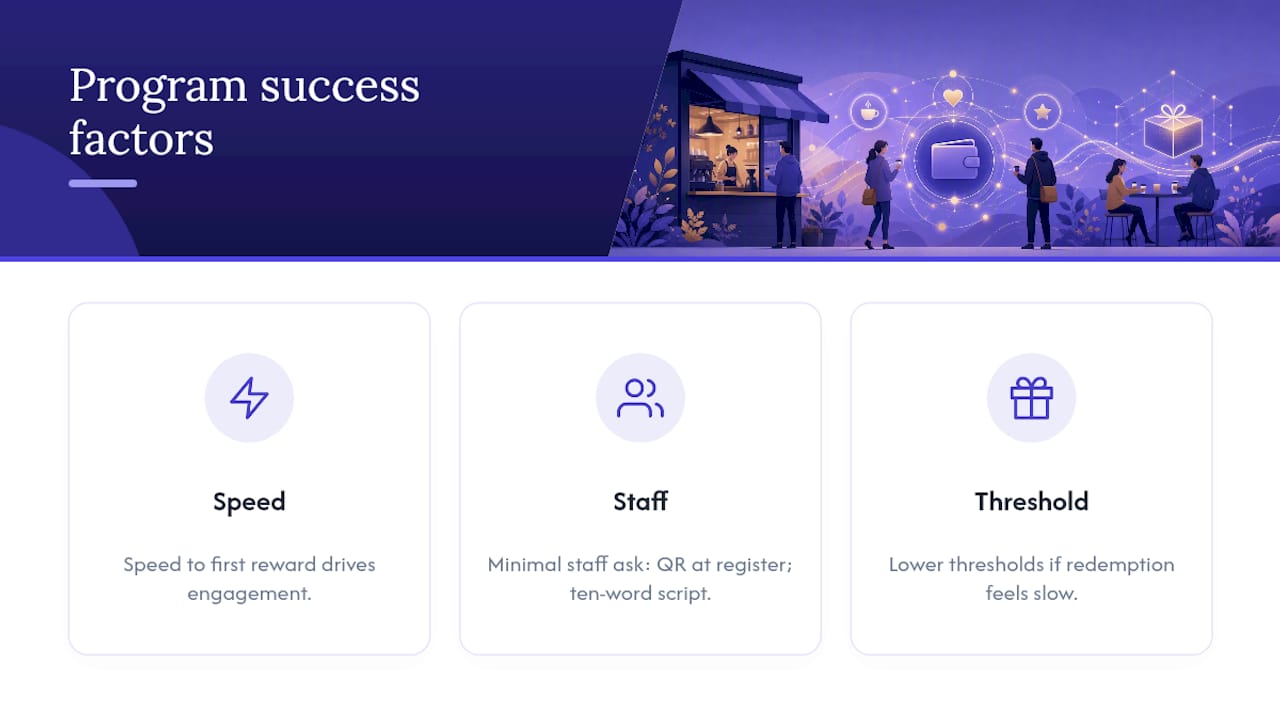
Three things worth trying this month: shorten your reward threshold if redemption feels slow, put a QR code directly at the register instead of relying on a poster near the door, and train every staff member on the same ten-word enrollment script so consistency doesn't depend on who's working that shift.
The pitfalls that sink most programs aren't exotic. They're unnecessary complexity (tiers and multipliers before you've even tested a basic points system), slow first rewards that make customers give up before they see any benefit, and inconsistent staff buy-in where only the owner ever mentions the program. Fix those three and most of the hard work is done.
One thing that keeps programs alive past the first three months: rotate in a small surprise offer every few weeks, not tied to any threshold, just a "thanks for being a regular" free pastry. It costs almost nothing and it's the detail customers actually mention to friends.
— Vitor
How Increasify Makes This Easy to Set Up and Run
Increasify is the practical shortcut to everything covered above: a wallet-native digital loyalty card that customers add to Apple Wallet or Google Wallet in seconds, with no app download and no separate account to create. Enrollment happens through a single QR code at your register, which solves the exact friction problem that kills most paper and app-based programs before they get traction.
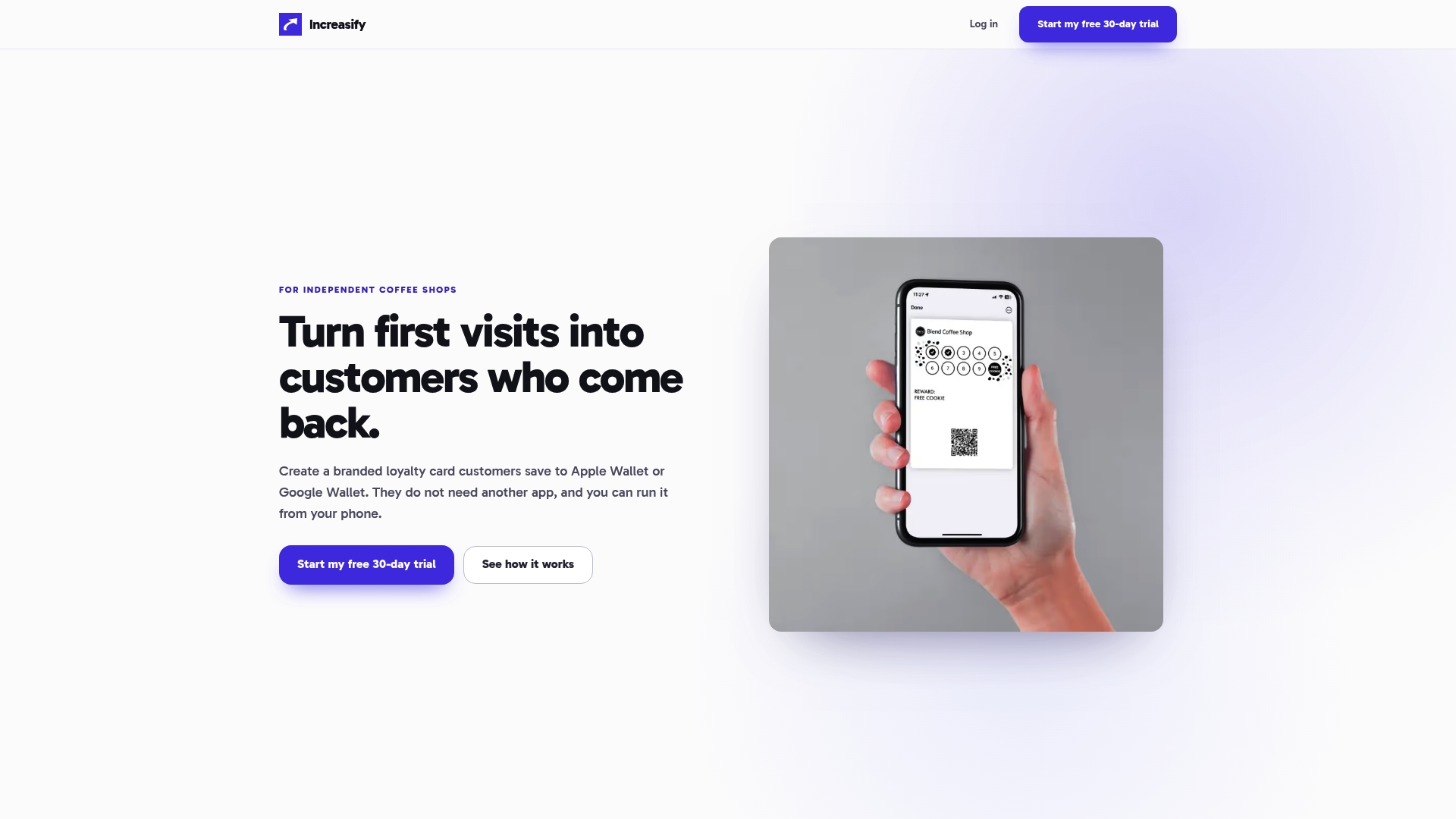
Every piece of the launch checklist above maps directly onto what Increasify handles for you: automatic reward tracking instead of manual punch counting, built-in return and promotional messaging so you're not writing re-engagement texts by hand, and reporting that shows sign-up and redemption numbers without you pulling data manually from a POS. Energy Bar, an independent shop using Increasify, saw 50% of enrolled customers return within 30 days of switching to this exact setup: wallet card, QR sign-up, and an immediate welcome reward.
If you're ready to stop losing customers to a lost paper card or an app they never downloaded, try Increasify's digital loyalty card system with a free 30-day trial and get your QR sign-up running before your next morning rush.